
ENGINEERING & CAD
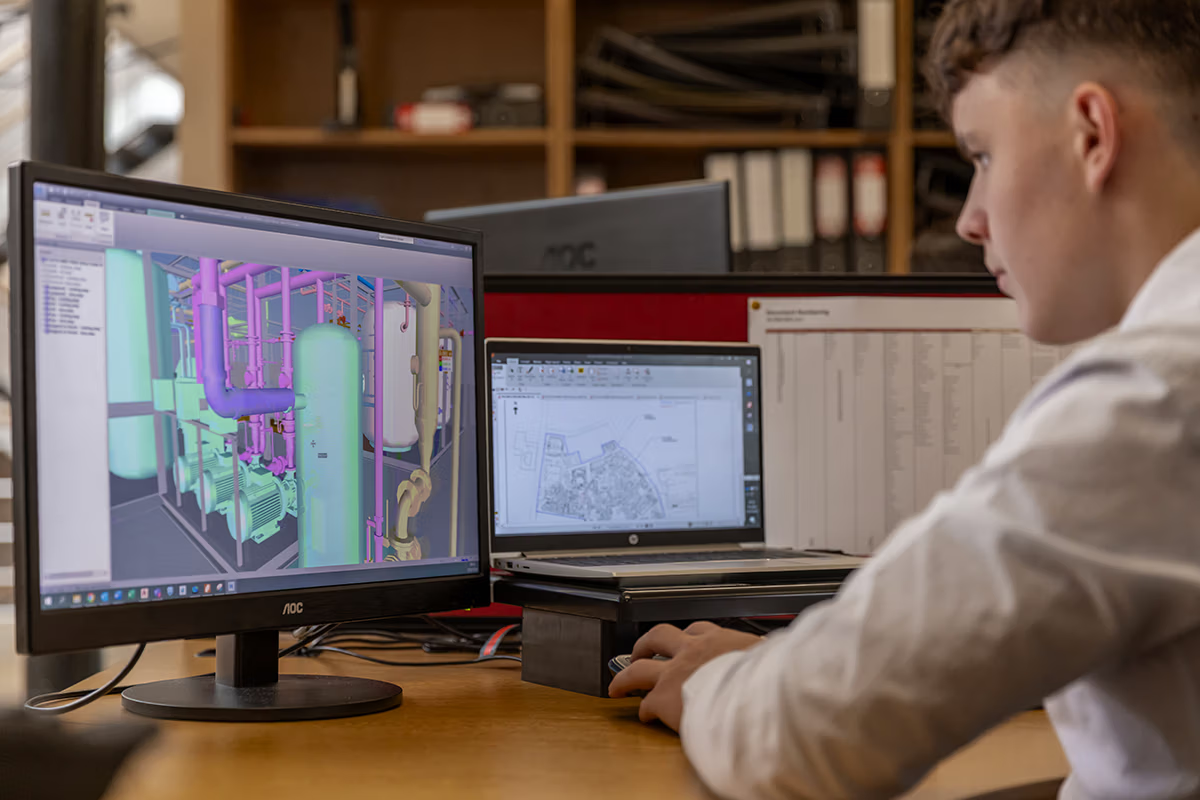
The models outgrew the pipe.
A laser scan of a single floor plate runs into the hundreds of gigabytes. A Computational Fluid Dynamics (CFD) run produces a result set nobody can email. A federated coordination model, a full drawing package at issue, a reality capture survey off a drone – each one has to reach a consultant, a fabricator, a client, or a site office, and most of them are outside your network.
The workarounds are familiar. VPN sessions that crawl across a WAN. An overnight upload that fails at 90% and starts over. A courier and a hard drive, which is still the fastest option often enough to be embarrassing. Or a consumer file service, which caps out below a single scan and puts your client's design IP on somebody else's infrastructure.
Every one of those gets worse the more external the team is. From subconsultants to specialist analysts, fabricators, surveyors, and the client's own reviewers, everyone suffers when waiting on data.
Your servers on both ends. Nothing in the middle.
JetStream is deployed on infrastructure you already control: on-premise, or in your own cloud account. Data moves point-to-point between your systems and your partners' over a proprietary transfer protocol, at whatever speed the network allows.
No intermediary service holds the data in transit. For a firm whose contracts specify where client design IP may reside, that removes a question rather than answering it.
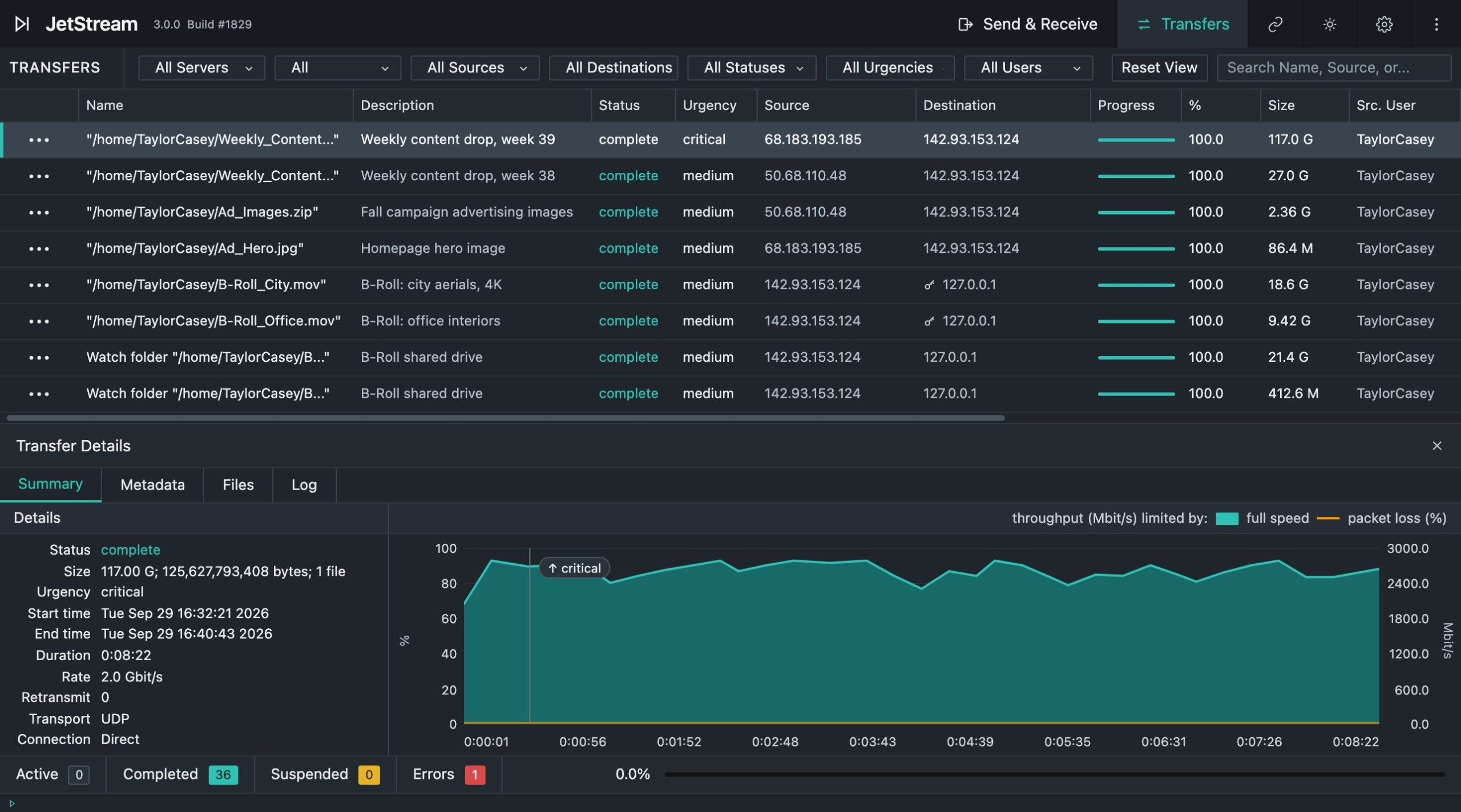
Not a replacement for your document management system.
JetStream doesn't do submittals, RFIs, transmittal logs, or drawing revision control, and it isn't trying to. Your project platform is the system of record and should stay that way.
What it does is move the payloads those platforms handle badly – multi-hundred-gigabyte point clouds, simulation result sets, render output, full scan surveys – and move them to people who don't have a seat on the platform. Most document management systems were built for documents. A 400GB E57 file is not a document.
The two work together: the platform holds the record, JetStream moves the data.
Predictable cost. Design IP that stays yours.
Your infrastructure, your storage.
On-premise, your own cloud account, or S3. Client design IP stays inside the perimeter your contracts already describe.
Per-server licensing.
Not per seat and not per gigabyte. A project with forty external collaborators costs the same as one with four, which makes JetStream straightforward to carry on a fee proposal.
Folder structure preserved.
Model sets, scan projects, and analysis output arrive as organized as they left. Folders transfer without zipping, and Watch Folders preserve source structure end to end.
Encryption and authentication you already run.
AES-256/GCM at the transfer level, TLS 1.3 on the server connection, authentication against PAM, Active Directory, or LDAP, with users sandboxed to specific directories.
How do you transfer very large CAD or point cloud files?
Point-to-point, with a transfer server at each end. JetStream moves data over an accelerated transfer protocol at whatever speed the network allows, with no cap on file size. Transfers resume from the point of interruption rather than restarting, which is what makes multi-hundred-gigabyte scan data practical to send.
Does JetStream replace ProjectWise, Autodesk Construction Cloud, or Procore?
No. Those platforms are systems of record for submittals, RFIs, and drawing revision control. JetStream moves large datasets (e.g. point clouds, simulation output, scan surveys, render output) including to people who don't have a seat on your platform. They're complementary.
Can we send files to consultants who don't use JetStream?
Yes. Send a shareable download link and the recipient downloads in a browser with no software to install and no account to create. Each link can carry a password and an expiry date, and is served from your own server rather than a public file sharing service.
Does our client's design IP pass through a third party?
No. JetStream is deployed on infrastructure you control at both ends, and data moves directly between your systems and your partners'. There is no vendor-operated service in the transfer path.
How is JetStream priced for project teams?
Per server, not per seat and not per gigabyte. The client application can be distributed to subconsultants, fabricators, and client reviewers at no extra cost, so the number of people on a project has no licensing consequence.
Does folder structure survive the transfer?
Yes. Watch Folders preserve source folder structure end to end, and folders transfer without zipping so model sets, scan projects, and analysis output arrive organized as they left.