
JETSTREAM
Built to use the whole connection
JetStream's transfer engine keeps the pipe full, using every bit of bandwidth available to you. Conventional transfers treat packet loss as congestion and back off, so the further your data travels the less of your bandwidth it actually uses. JetStream's transfer engine measures the link and keeps it full.
The transport layer allows the fastest protocol for the conditions between two locations to be selected. When conditions change mid-transfer, JetStream re-tunes rather than stalling.

Never times out. Always adapts.
Packet loss, latency spikes, congested links – JetStream re-tunes on the fly and keeps delivering. Where conventional transfers stall and fail, yours just finish.
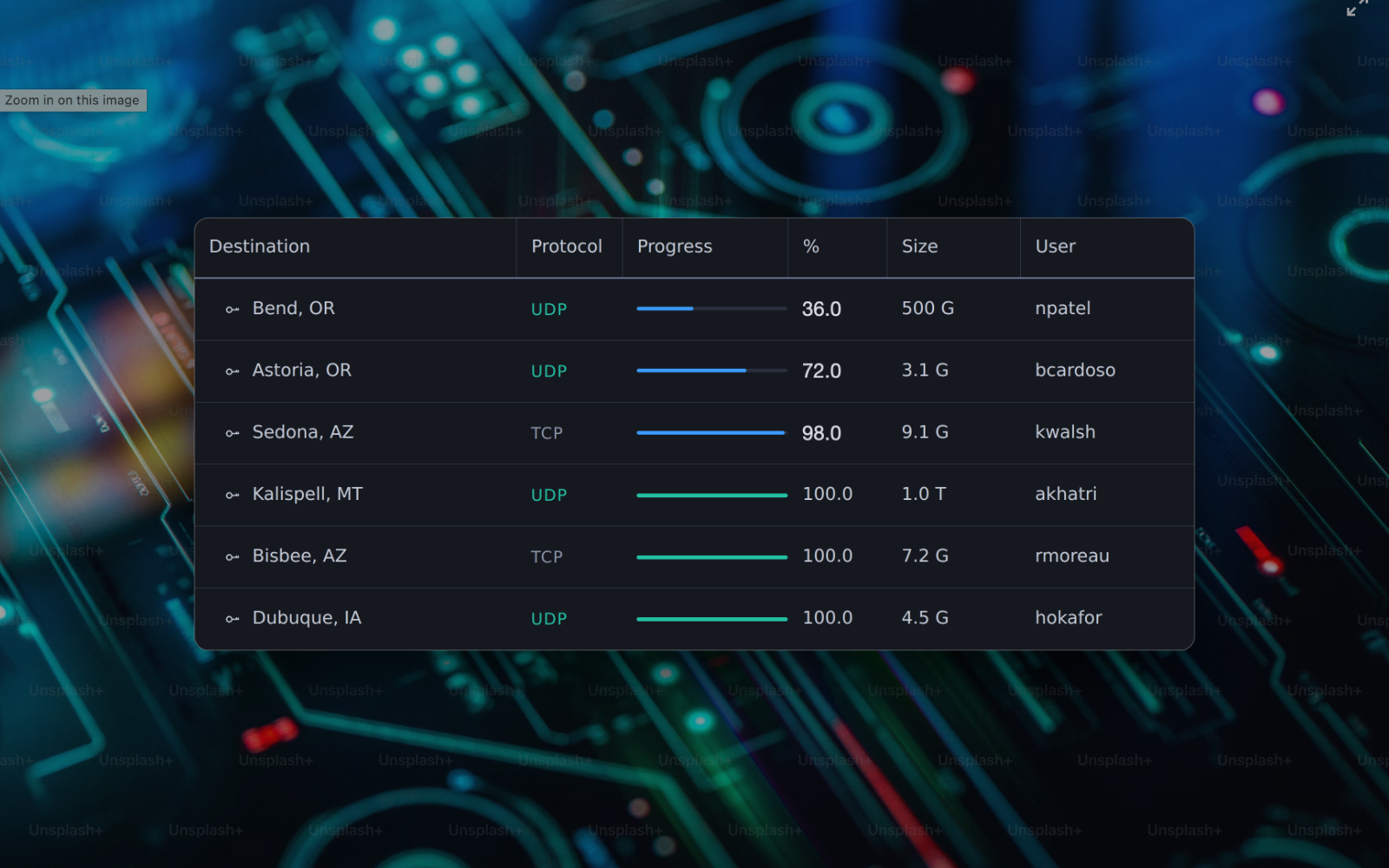
Your servers, your storage, your rules.
JetStream uses a client-server architecture. You deploy the server; data moves point-to-point between your people and your systems. Use whatever storage you already have, on-premise or cloud.
Nothing passes through a third-party relay. For teams handling pre-release media, client footage, or anything under an NDA, that's usually the whole argument.
Decide what moves first.
Most file transfer services run a first-in, first-out queue. JetStream gives you priority tiers so the urgent job goes first without pausing everything else. Beneath the tiers, you can set bandwidth ceilings on individual low-priority transfers.
Send a link. No install at the other end.
Recipients don't need the JetStream desktop application — send a link and they download in the browser. Clients, partners, freelancers, anyone you can email.
Links are created and served by an on-premise server, so files stay on infrastructure you control. Set a password and an expiry date per link, and decide how the link travels.
Secure by default.
AES-256/GCM encryption at the transfer level and TLS 1.3 on the server connection. The security layer covers data confidentiality, data integrity, and packet replay protection. Default settings are the most secure available; change them only if you need to.
Authenticate users against PAM, Active Directory, or LDAP. Sandbox users to specific directories, and exclude file types from transferring entirely.

Disappears into your workflow.
JetStream is API-first. Watch Folders automate recurring transfers and preserve source folder structure, and the open API lets you embed transfers directly into an existing pipeline.
The API is published online and included at no additional cost. Most vendors charge for it.
What's in JetStream
What is accelerated file transfer?
Accelerated file transfer moves data at the full speed a network can carry, rather than the reduced speed that distance and packet loss usually impose. Conventional transfer methods treat lost packets as congestion and slow down, so the further a file travels the less of your available bandwidth it actually uses. JetStream measures the link and keeps it saturated instead. The gain is largest on long, busy or unreliable routes – the ones where conventional transfers lose the most.
Is JetStream hosted or self-hosted?
Self-hosted. You deploy the JetStream server on your own infrastructure or in your own cloud account, and data moves point-to-point without passing through a third-party relay. Since version 3.0, recipients can download in a browser without installing anything.
That means files stay inside the perimeter you already run – your network, your storage, your directory – with no vendor-operated service holding them in transit and no additional processor for your security team to assess. It also means cost is fixed in advance: licensing follows how many servers you run rather than how much data you move, so there are no per-gigabyte charges, no egress fees, and no invoice that spikes in a busy month.
What makes JetStream faster?
It uses the whole connection. A conventional transfer over a long or lossy route typically uses a fraction of the bandwidth available to it, and the gap widens the further the file travels. JetStream holds the line saturated regardless, so on international routes transfers that took hours finish in minutes.
Is there a limit on file size or transfer volume?
No limit on file size or transfer volume, and nothing is throttled nor metered. Allocate as much of your available bandwidth as you choose, up to 5 Gb/s.
How is JetStream licensed?
Per server, not per seat. You are charged for the number of servers you deploy, and the client application can be distributed to every collaborator, partner, and vendor at no extra cost. API access, software updates, and support are included.
What storage does JetStream work with?
Your own on-premise servers, your cloud storage, or Amazon S3. The client-server architecture moves data point-to-point between your people and your systems, so you keep whatever storage you already have.
Can transfers be automated?
Yes. Watch Folders automate recurring transfers and preserve source folder structure. The open API is published online and included at no additional cost, so JetStream can be embedded directly into an existing workflow.